
Designing a reliable ALPR system often introduces a tough dilemma: double the cameras to cover both entry and exit lanes, or sacrifice visibility to stay within budget. Standard security installations frequently mandate two separate hardware units at a single choke point—one focused on incoming traffic and another dedicated to outgoing vehicles.
While high-traffic perimeters or multi-lane entrances still rely on dual-camera setups to handle steep angles and extreme night lighting, paying for two units at low-speed, single-lane access points is an unnecessary expense. Intelligent “Stream Direction of Travel” software enables a single high-resolution camera to monitor both inbound and outbound lanes simultaneously. The system tracks the vector movement of a license plate on car in real time, accurately determining whether a vehicle is approaching or receding. Utilizing this software logic cuts installation costs, halves your hardware footprint, and delivers total operational coverage without missing a single frame.
This guide breaks down how to strategically deploy a single-camera ALPR strategy across your property. We explore how direction-of-travel algorithms process vehicle data, examine critical mounting regulations for a license plate for front of car, and map out legal plate mandates across all 50 states to maximize your capture confidence.
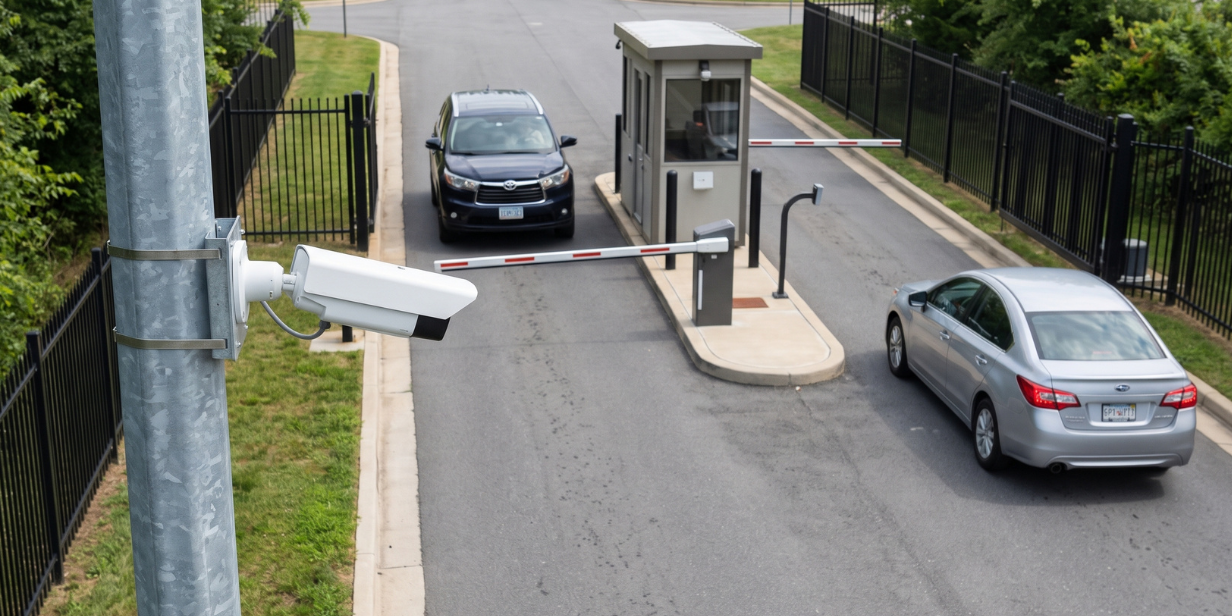
Cars entering and exiting a property with a single-camera set up on a pole. Source: Gemini-Generated Image
Maximize Perimeter Coverage with One Camera per Lane
Translating that operational efficiency into practice begins with rethinking standard perimeter architecture. Deploying a single-camera strategy bridges the gap between total coverage and lean infrastructure, eliminating unnecessary hardware without sacrificing read accuracy.
Challenging the Dual-Camera Standard
Traditional security design dictates installing two separate hardware units at every access lane. While effective, this setup doubles infrastructure costs across every lane—requiring additional mounting poles, trenching, network switch ports, power drops, and software licenses. Modern software logic eliminates the need for redundant hardware by turning single camera streams into dual-lane capture solutions.
Understanding “Stream Direction of Travel” Logic
Advanced ALPR engines process directional vectors directly inside the live video stream. Rather than treating every frame as an isolated image, the system tracks vehicle trajectories across sequential frames in real time:
- Approaching Vectors – Pixel dimensions of optical characters expand frame-by-frame as a vehicle moves toward the lens, tagging the event as an inbound entry.
- Receding Vectors – Plate dimensions contract as a vehicle moves away from the sensor, instantly logging an outbound departure.
Analyzing vector direction allows a single high-resolution camera positioned at a choke point—such as a parking gate, single-lane access road, or HOA entrance—to separate inbound and outbound vehicle data into clean, distinct event logs.
The Single-Camera Logistics Setup
Executing this strategy effectively depends on regional plate mandates:
- In Dual-Plate States – A single camera positioned head-on at a choke point captures an approaching license plate for front of car upon entry, and reads the same vehicle’s rear plate receding as it exits.
- In Rear-Only States – Mounting the camera downstream looking back at the lane enables the system to log entering vehicles as their rear bumper recedes, while catching exiting vehicles as they approach the camera head-on.
Both scenarios achieve complete bi-directional coverage using a single optical sensor.
Cost vs. Coverage: The Economic Breakdown
Taking these hardware logistics to the bottom line highlights how lean your infrastructure becomes. Consolidating bi-directional capture into a single optical sensor eliminates redundant hardware while cutting ongoing expenses across installation, cabling, and software maintenance:
| Overhead Category | Dual-Camera Setup | Single-Camera Setup | Financial & Operational Impact |
|---|---|---|---|
| Hardware Costs | 2 Cameras per lane | 1 Camera per lane | 50% savings on camera hardware |
| Infrastructure & Cabling | Dual POE runs & switch ports | Single POE run & switch port | Halves cabling, trenching, and switch port usage |
| VMS & ALPR Licensing | 2 Active camera streams | 1 Active camera stream | Cuts recurring software licensing fees in half |
| Maintenance & Failures | Double the physical points of failure | Single endpoint per choke point | Reduces ongoing field maintenance costs |
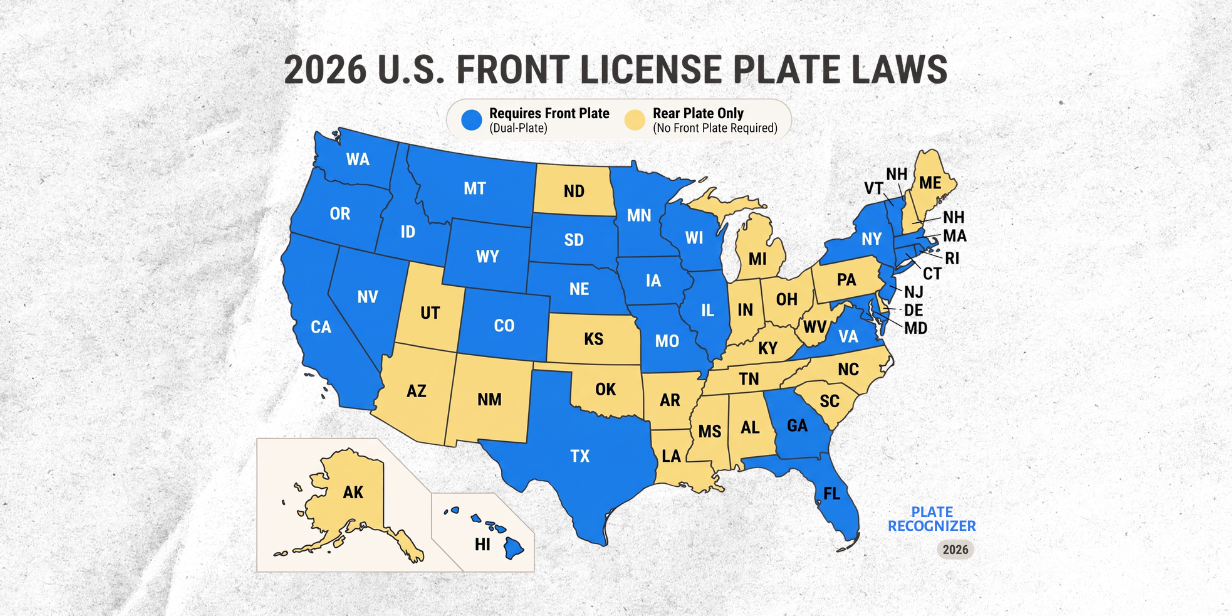
2026 Map with US States that have Front Plate and Rear Plate Requirements. Source: Gemini-Generated Image
The 2026 State Compliance & Mounting Master Table
Software-driven single-camera ALPR delivers the same cost savings across every jurisdiction. The only variable is camera orientation, which adapts to local plate regulations:
- In Dual-Plate States (28 States + D.C.) – Pointing the camera head-on captures front plates as vehicles arrive and rear plates as they leave.
- In Rear-Only States (22 States) – Placing the camera downstream facing backward captures rear plates as vehicles arrive (receding) and as they exit (approaching).
The table below maps state-by-state mandates to the correct single-camera deployment setup:
| State Grouping (2026) | Applicable Jurisdictions | Front Plate Status | Mounting & Visibility Standards | Single-Camera Deployment Strategy |
|---|---|---|---|---|
| Dual-Plate States | CA, CO, CT, DC, HI, ID, IL, IA, ME, MD, MA, MN, MO, MT, NE, NV, NH, NJ, NY, ND, OR, RI, SD, TX, VT, VA, WA, WI, WY | Required | Securely attached at front and rear; 12″–60″ from ground level. Must be horizontal, unobscured, and illuminated. | Head-On Single Camera. Mount one camera at the choke point facing inbound traffic. Direction-of-travel software logs front plates as vehicles arrive and rear plates as they exit. |
| Rear-Only States | AL, AK, AZ, AR, DE, FL, GA, IN, KS, KY, LA, MI, MS, NM, NC, OH, OK, PA, SC, TN, UT, WV | Not Required | Fastened permanently to the rear bumper/bracket; unobstructed by tinted covers, smoke shields, or frames. | Rear-Facing Single Camera. Mount the camera downstream looking back at the lane. The system uses receding OCR logic for entering vehicles (moving away) and approaching OCR logic for exiting vehicles (moving toward the camera) to capture rear plates in both directions. |
| Special Exemptions
(Historic, Classic, & Tow-Hook Class) |
Varies by State Law (e.g., Antique/Collector status in TX, WA, MA, NV) | Conditional | Dash placement is illegal nationwide. Plates must use exterior bumper mounts or dedicated brackets. | Software Fallback Configuration. Configure orientation rules and vehicle classification so front-exempt vehicles don’t trigger failed reads or missing plate alerts. |
Key Compliance Note: Always verify local municipal codes alongside state statutes when calibrating OCR recognition rules, as specific vehicle classes or temporary exemptions can alter mounting compliance on site.
Critical Mounting Requirements & Compliance
Knowing whether a state mandates a front plate tells you where to point your camera, but meeting physical mounting standards determines whether your system actually reads the characters. Standardized placement of a license plate on a car ensures that the OCR engine processes plates at high speeds without generating missed reads or false alerts. Physical mounting violations degrade optical readability, rendering even the most advanced direction-of-travel algorithms ineffective.
1. The Windshield Violation
Placing a license plate for front of car on the dashboard or wedging it inside the windshield is illegal across virtually all dual-plate jurisdictions.
- Legal Mandate – State statutes (such as California Vehicle Code 5201 and Texas precedent Spence v. State) strictly require plates to be mounted at the foremost exterior point of the bumper.
- Optical Impact – Glass glare and interior windshield reflections block infrared (IR) camera illuminators, rendering the plate virtually invisible to automated optical sensors.
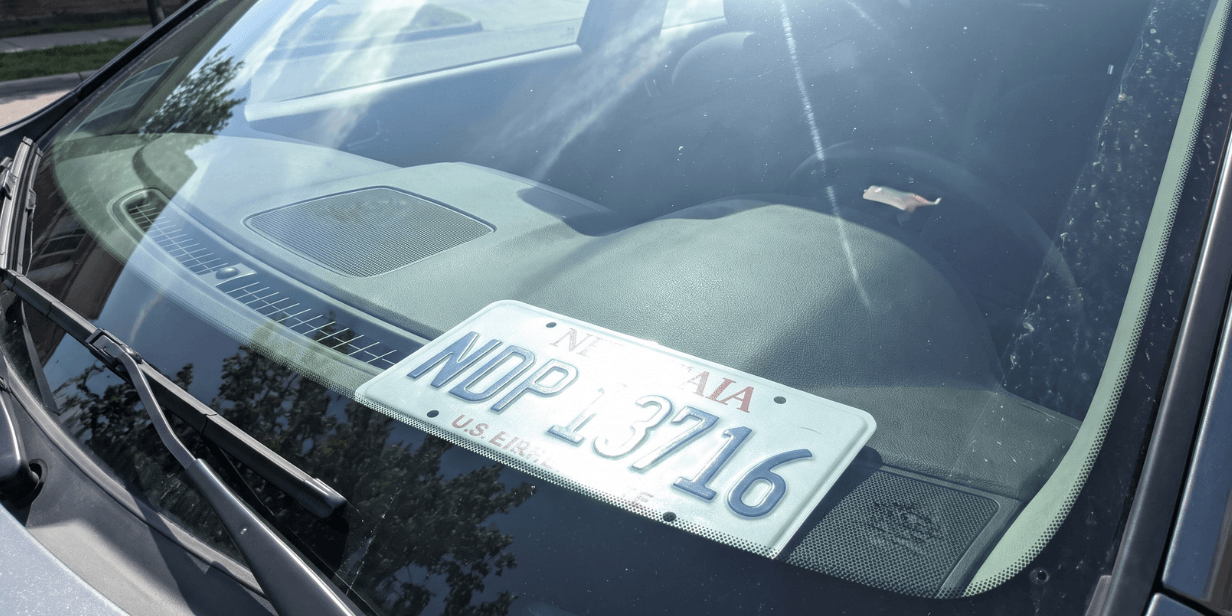
License Plate in a windshield of a car. Source: Gemini-Generated Image
2. Geometric Precision & Camera Angles
Maintaining proper camera-to-target geometry prevents character distortion during vector tracking:
- Horizontal Angles – The camera mount must maintain a horizontal capture angle under 30 degrees relative to the vehicle’s direction of travel. Angles steeper than 30 degrees distort text proportions, significantly lowering AI confidence scores.
- Vertical Clearance – Exterior bumper mounts must sit within standardized height ranges (typically 12 inches to 60 inches from ground level) to stay within the camera’s primary focal plane.
3. Obstruction Penalties & Tinted Covers
Tinted covers, “smoke” shields, and wide decorative frames represent a primary point of failure for ALPR deployments:
- Shield Restrictions – Clear, tinted, or anti-glare plate covers are explicitly banned or strictly restricted in states like California, New York, Florida, and Illinois.
- Infrared Absorption – Tinted covers absorb IR light, causing the camera sensor to see a blacked-out rectangle rather than high-contrast characters.
- Frame Intrusion – Mounting brackets must leave registration numbers and state identifiers fully visible to satisfy statutory license plate mounting requirements US states law.
Categorized State Reference List
Here’s a categorized reference list that simplifies identifying which setup applies to your target location:
Dual-Plate Jurisdictions (28 States + D.C.)
Vehicles registered in these jurisdictions must display both front and rear plates, making them ideal for head-on single-camera setups:
|
|
Rear-Only Jurisdictions (22 States)
Vehicles registered in these jurisdictions require only a rear license plate, mandating downstream rear-facing camera setups for entering and exiting traffic:
|
|
Recent Legislative Trends & Software Adaptation
Regional plate regulations evolve as state legislatures evaluate manufacturing costs against law enforcement needs. Transitioning to software-driven camera configurations ensures systems remain fully functional despite regulatory updates.
Shifts Toward Single-Plate Mandates
States periodically revise mounting statutes to cut budget overhead and eliminate vehicle design issues. Utah officially transitioned to a single-plate requirement via Senate Bill 45, joining states like Ohio and Alaska that previously eliminated front plate mandates. Furthermore, Nebraska passed Legislative Bill 97, which officially shifts the state to a single rear-plate mandate starting January 1, 2029. Tracking these statutory updates helps security managers adjust camera positioning without purchasing new hardware.
Eliminating Cross-Border Read Errors
Properties operating near state lines handle high volumes of mixed traffic from dual-plate and rear-only jurisdictions. Without intelligent cross-border logic, incoming rear-only vehicles trigger continuous “Missing Plate” alerts on head-on systems. Advanced ALPR software resolves this operational bottleneck automatically:
- Instant Plate Template Identification – The optical engine identifies regional plate layouts upon initial frame entry, instantly applying state-specific recognition rules.
- Dynamic Vector Fallback – When a vehicle enters the capture zone, the software uses MMVR (Make, Model, and Vehicle Recognition) to track the vehicle’s body signature. If a head-on camera detects no front plate, the system holds the transaction open. [Note: If using a single camera, complete bi-directional coverage requires a downstream/rear-facing mount rather than a head-on mount to ensure a plate is always visible in both directions.]
- Automated Confidence Thresholding – If frontal OCR confidence scores drop below target thresholds due to a missing plate, the engine instantly switches its tracking priority to vehicle fingerprinting (color/make/model) to minimize false alarms.
- Unified Event Correlation – The ALPR engine or VMS integrates timestamp, vector movement, vehicle color, and make/model data into a single verified entry. This provides security operators with a complete audit trail while cutting hardware overhead across every lane.
Plate Recognizer Stream delivers these enterprise features out of the box, eliminating complex custom rule building and hardware additions. Built with advanced machine learning, Plate Recognizer Stream processes live video feeds on-premises or in the cloud, using AI-driven Make, Model, Color, and Body Type Recognition (MMVR) to track complete vehicle profiles even when front plates are absent. For properties running gated entries, traffic monitoring, or automated access control, pairing Stream with ParkPow parking management software correlates cross-border vehicle data instantly, keeping lane traffic flowing smoothly without triggering false security alarms.
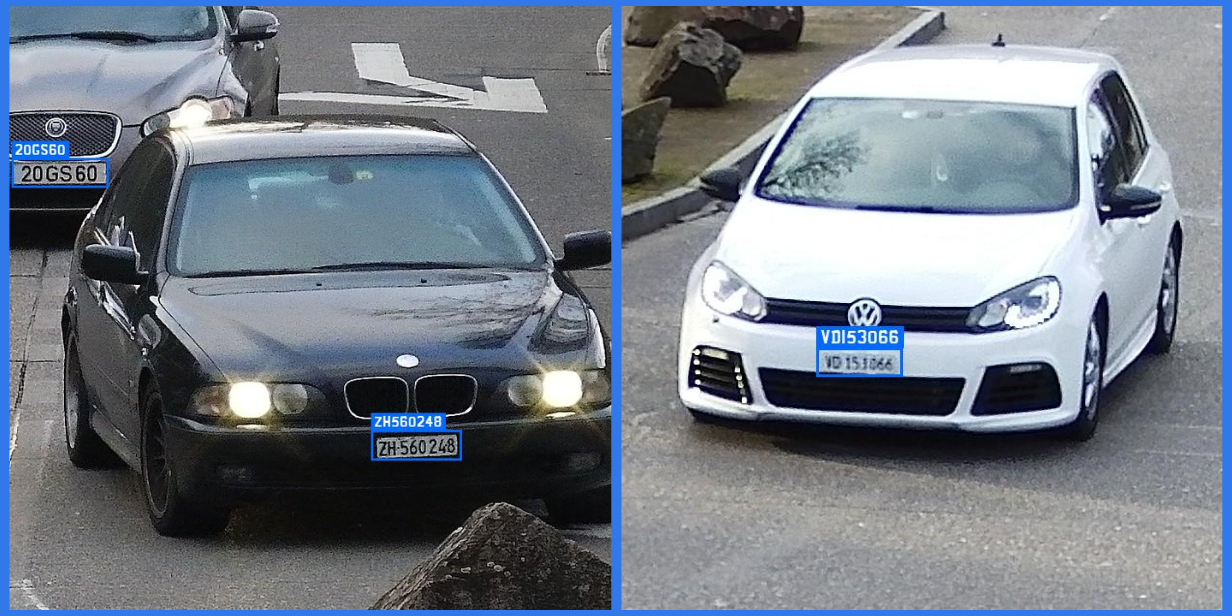
Automated license plate recognition software detects and reads front license plates in real time across multiple access lanes. Source: Plate Recognizer
Strategic Deployment Summary
Deploying software-driven single-camera ALPR cuts hardware footprints, lowers ongoing maintenance costs, and slashes recurring software licensing fees across every access lane. Aligning camera positioning with state legal mandates and leveraging intelligent direction-of-travel algorithms allows security and property operators to achieve complete bi-directional coverage without redundant hardware.
Ready to optimize your site perimeter while cutting infrastructure costs in half? Try Plate Recognizer Stream—our lightweight, high-accuracy ALPR software that turns any single IP camera feed into a complete bi-directional vehicle monitoring solution. Start your 14-day free trial to test your camera feeds, or contact our sales team to build a custom single-camera deployment plan for your site.