
Today, our world is more monitored than ever before, with an estimated one billion surveillance cameras installed across the globe. Originally appearing in the 1970s to protect tourists and deter “deviant” behavior, Closed-Circuit Television (CCTV) has since become a fundamental tool for state surveillance, social monitoring, and crime prevention.
However, this technological reach is not distributed equally. While many nations use a video surveillance system to improve public safety and manage traffic through tools like Automatic License Plate Recognition (ALPR), certain countries have integrated these tools into the very fabric of their urban planning. This rapid expansion has fueled a global debate regarding the delicate balance between public security and privacy. As governments navigate the complexities of video surveillance law, the following research examines the top 10 countries currently leading this surveillance surge and the specific ways they utilize advanced technology to monitor their populations.
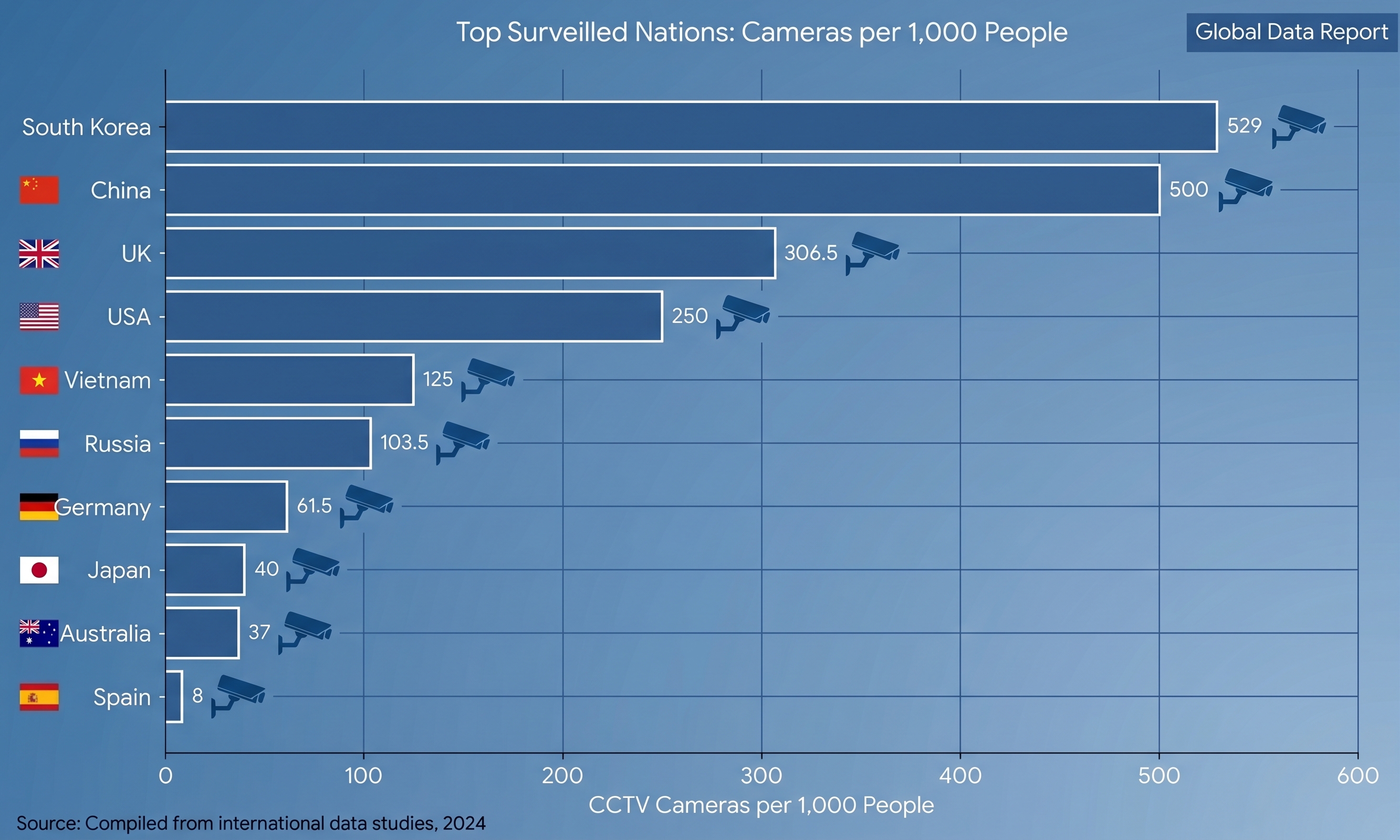
Bar chart showing cameras per 1,000 people across top surveilled nations including China, United States, and United Kingdom. Source: See Table Global Surveillance Comparison
Global Surveillance Comparison Table
|
Country |
Key Technology / Program |
National Estimated Cameras (Millions) |
Metric (per 1,000 people) |
Categorized Use Case |
|---|---|---|---|---|
|
China |
Skynet / Golden Shield |
500 |
Social Governance & Compliance |
|
|
USA |
Domain Awareness / SoundThinking |
244 – 256 |
Public Safety & Gunshot Detection |
|
|
S.Korea |
Smart City Integrated Platform / Dejaview / TTA Security Certification/ Context-Aware Generative AI Monitoring |
529 |
Public Safety & Crime Prevention, Emergency Rescue & Disaster Management, Commercial & Private Security |
|
|
UK |
National ANPR Strategy |
304 – 309 |
Traffic & Infrastructure Management |
|
|
Russia |
“Safe City” (Безопасный город) / FindFace Multi / Multifunctional Camera Integration |
103 – 104 |
Social Governance & Compliance. Smart City & Infrastructure Management, Commercial Security & Private Monitoring |
|
|
Vietnam |
Urban Infrastructure Monitoring |
100 – 150 |
Traffic & Infrastructure Management |
|
|
Germany |
Public CCTV / BDSG Regulations |
61 – 62 |
Private & Community Security Collaboration |
|
|
Japan |
Integrated Disaster & Urban Safety |
40+ |
Disaster Resilience & Urban Monitoring |
|
|
Australia |
National CCTV Network |
37+ |
Private & Community Security Collaboration |
|
|
Spain |
The AEPD Video Surveillance Protocol |
900K+ |
8+ |
High-Density Public Transit Monitoring , Autonomous Traffic & Speed Enforcement , Private Asset & Retail Protection |
National Surveillance Profiles: A Deep-Dive into the Top 10 Nations
While the global total of surveillance cameras has vastly expanded, the application and density of this technology vary significantly by region. Below is a detailed, data-verified look at how the world’s top 10 heavily surveilled nations deploy and utilize their networks.
1. China: The Global Leader
China is the undisputed leader in state monitoring, with a national camera network estimated between 400.0M and 700.0M units. This infrastructure yields a massive density of 280 to 500 cameras per 1,000 people. Driven by state-wide initiatives like Skynet and the Golden Shield program, the system integrates data from utilities, banks, and retail networks using AI-powered facial and automobile recognition loops. In specific regions like Xinjiang, the surveillance framework is even more invasive, incorporating automated video analytics to track population mobility and compliance.
2. United States: High-Density Monitoring
The United States maintains a high-density surveillance presence, with a national total estimated well exceeding 85.0M active cameras according to historical data from the Wall Street Journal. This infrastructure establishes a footprint averaging over 250 cameras per 1,000 people, a penetration rate detailed by TelecomTV. Since the September 11 attacks, municipal, commercial, and residential security frameworks have rapidly expanded. Current deployments heavily rely on highly integrated public-private networks, such as New York’s Domain Awareness System, alongside specialized SoundThinking acoustic technology designed for automated gunshot detection.
This rapid integration is best exemplified by the widespread adoption of private camera grids into local police operations. However, this model has faced intense backlash, with Flock on the news exposing deep friction over mass vehicle tracking, unvetted inter-agency data sharing, and algorithmic false positives.
The commercial, consumer, and municipal market scaling driving these specific hardware volumes is comprehensively mapped out within industry market research and residential security metrics like those tracked in the SafeHome.org Home Security Market Report.
3. South Korea: Context-Aware Predictive Surveillance & Smart City Integration
South Korea operates an extensive video monitoring network totaling over 27M active units, creating a dense surveillance ratio of roughly 529 cameras per 1,000 citizens.
Central to this infrastructure is the nationwide Smart City Integrated Platform, which connects municipal CCTV networks directly with emergency services, police databases, and disaster management centers.
Public safety assets are subject to strict Telecommunications Technology Association (TTA) security certifications, ensuring hardware compliance and cybersecurity standards across both government and commercial deployments.
On the roadways, South Korea relies on advanced Automatic Number Plate Recognition (ANPR) systems integrated into urban intersections, highway tolling gates, and mobile police units.
Deep learning models dynamically process complex Korean alphanumeric character sets under challenging environmental conditions. The infrastructure is shifting toward context-aware generative AI monitoring, headlined by systems like “Dejaview“—developed by the Electronics and Telecommunications Research Institute (ETRI). This technology combines real-time vehicular and pedestrian tracking with historical spatiotemporal data to predict potential crimes, automate traffic violation enforcement, and assist in real-time emergency rescue operations.
4. United Kingdom: The ANPR Pioneer
The United Kingdom operates a sophisticated national surveillance grid, with a total camera footprint estimated between 5.0M and 6.5M active units. This infrastructure translates to a significant density of 75 to 95 cameras per 1,000 people. Historically a pioneer in automated tracking, the UK’s surveillance model focuses heavily on crime deterrence and metropolitan transport management. This is executed primarily through its National ANPR Strategy, which utilizes high-speed Automatic Number Plate Recognition (ANPR) frameworks to cross-check vehicle data against law enforcement databases in real time.
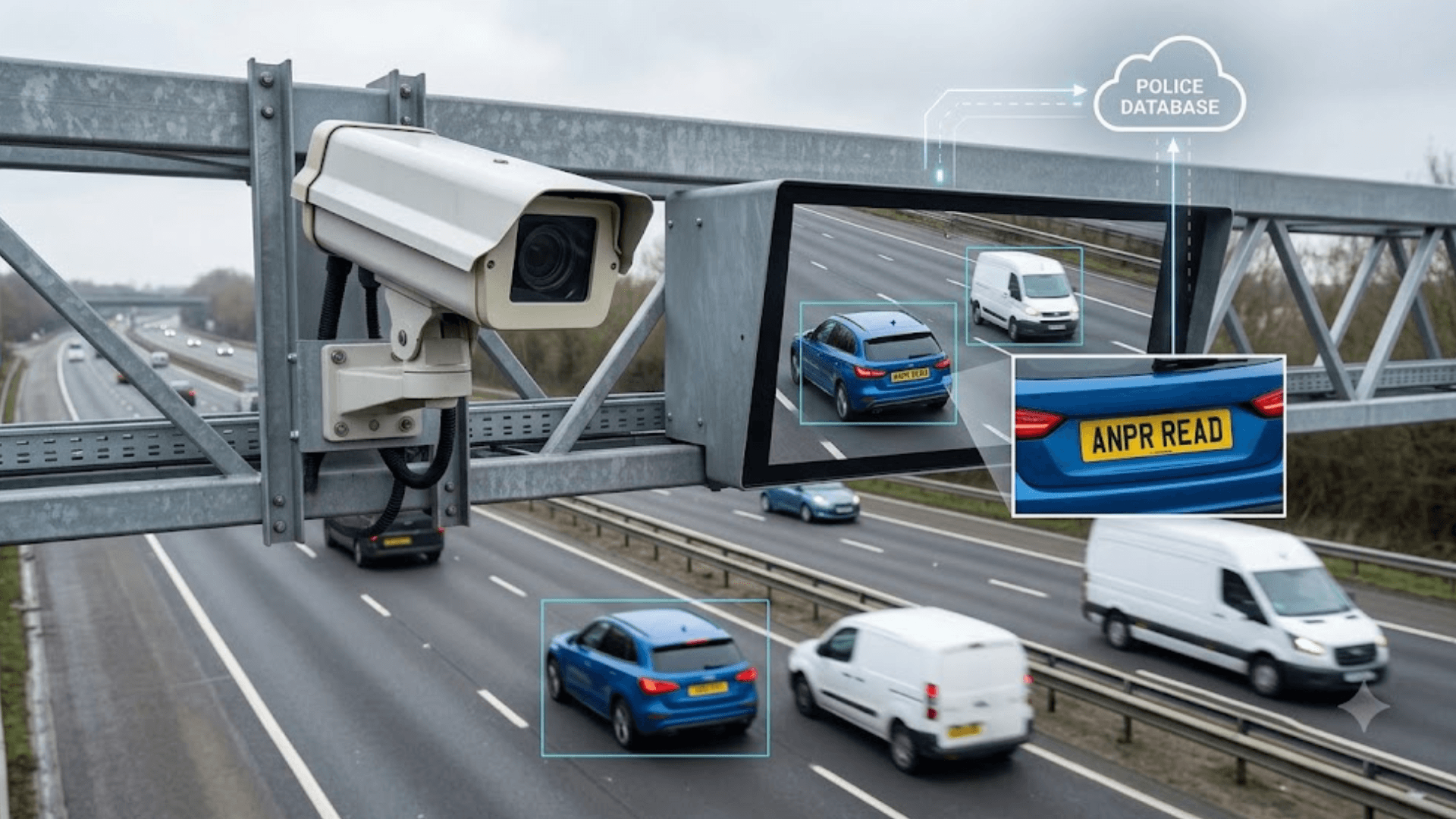
Automatic Number Plate Recognition ANPR camera mounted on a highway gantry capturing vehicle license plate data in real time. Source: AI-Generated Image
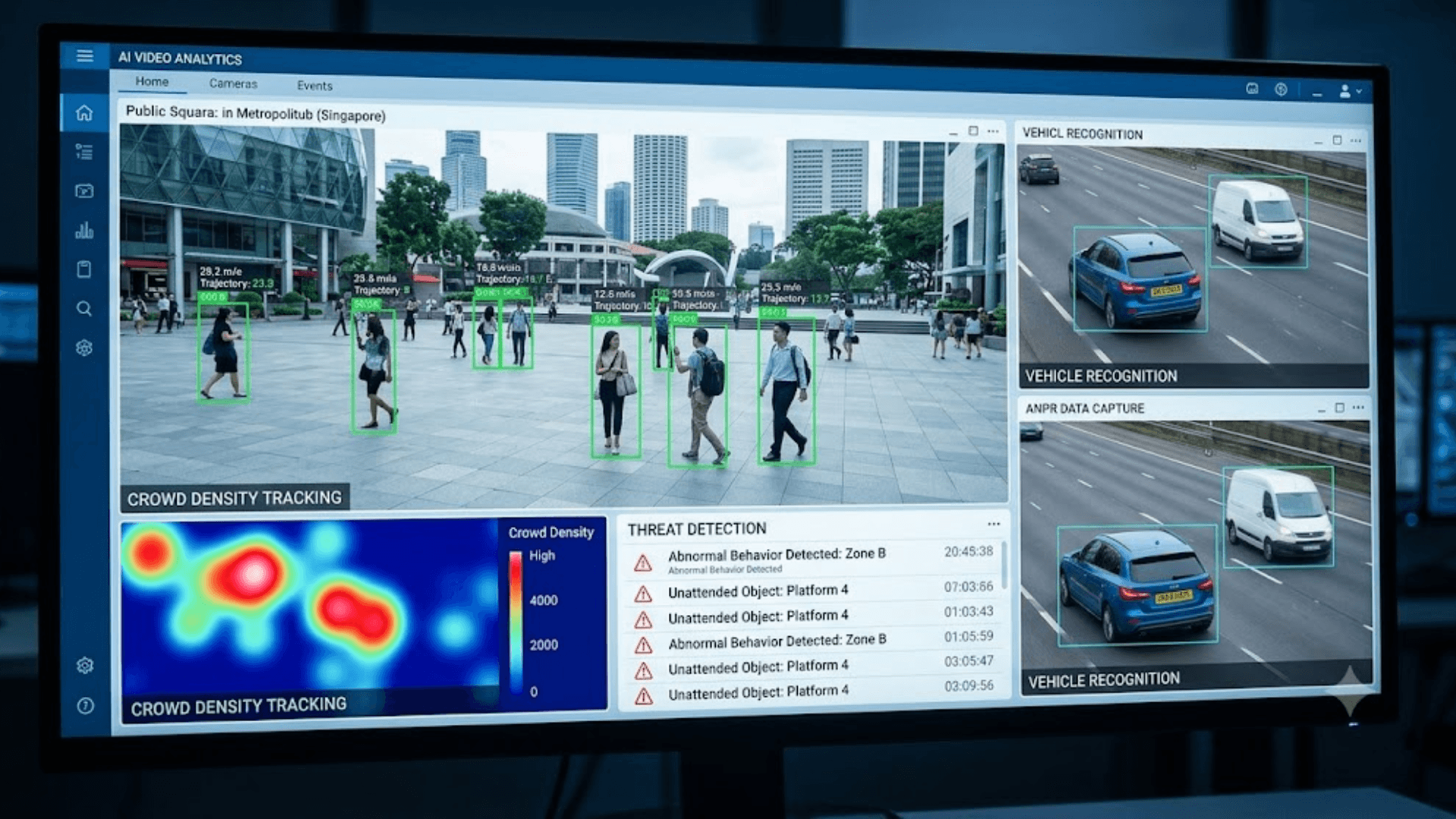
AI video analytics dashboard displaying real-time crowd density tracking and vehicle recognition overlays. Source: AI-Generated Image
9. Australia: Private & Community Security Collaboration
Australia maintains a nationwide video surveillance footprint exceeding 1.0M active CCTV cameras. This baseline creates a density of approximately 37 to 40 cameras per 1,000 citizens across metropolitan and regional areas.
The Australian surveillance network operates on strong public-private synergy, bridging state law enforcement with municipal and commercial monitoring feeds instead of relying on a single federal framework. State law enforcement agencies work closely with municipal councils, commercial entities, and residential communities to feed visual intelligence into local policing efforts.
On the roadways, automated license plate recognition plays an essential role in traffic management and law enforcement. State police forces—such as the New South Wales Police Force and Victoria Police—employ fixed gantry sensors alongside Mobile ANPR (MANPR) units integrated directly into highway patrol fleets. These high-speed optical systems continuously scan registration plates to identify unlicensed drivers, unregistered vehicles, and stolen cars while cross-referencing vehicle movements against law enforcement databases.
10. Spain: Privacy-Centric Protocols & Automated Traffic Infrastructure
Spain maintains a tightly regulated surveillance footprint with over 900K active CCTV cameras, resulting in a density of roughly 8 to 10 cameras per 1,000 residents. Governance is dominated by the Spanish Data Protection Agency (Agencia Española de Protección de Datos – AEPD), which enforces one of Europe’s most stringent video surveillance frameworks. Public-space recording by private actors is strictly prohibited, limiting municipality-led CCTV primarily to high-density public transit networks, major urban plazas, and private asset protection within commercial and retail environments.
On national motorways and urban corridors, Automatic Number Plate Recognition (ANPR) serves as the backbone for autonomous traffic management and speed enforcement. Governed by the Directorate-General for Traffic (Dirección General de Tráfico – DGT), fixed ANPR gantries, section control radars (tramos de velocidad media), and aerial monitoring platforms process vehicle registration plates in real time. These optical readers cross-reference registration data against national driver databases to enforce Low Emission Zones (Zonas de Bajas Emisiones – ZBE) in cities like Madrid and Barcelona, verify mandatory vehicle inspections (ITV), identify uninsured motorists, and detect speed violations while adhering to strict AEPD data retention limits.

Global map illustrating video surveillance camera density and network connectivity across major surveilled nations. Source: AI-Generated Image