Every year, U.S. infrastructure suffers from more than 14,500 bridge strikes, creating a massive financial drain on state budgets. These aren’t just traffic inconveniences; they are costly infrastructure failures.
In Texas alone, bridge repairs have been reported to cost the state nearly $6.7 million annually. Meanwhile, a single severe strike—like the I-65 tanker crash in Tennessee—can necessitate $1 million in emergency relief funds just to begin repairs.
For Transportation Agencies and Fleet Managers, the challenge has shifted. It is no longer enough to build stronger bridges simply. The modern goal is prevention through intelligence: detecting an oversize load before impact and identifying the violator in real-time.
This guide explores the technology behind Automated Weigh Stations and how sensor fusion—specifically combining LiDAR with Automatic License Plate Recognition (ALPR)—is solving the enforcement gap, featuring a real-world deployment by HyPoint Solutions.

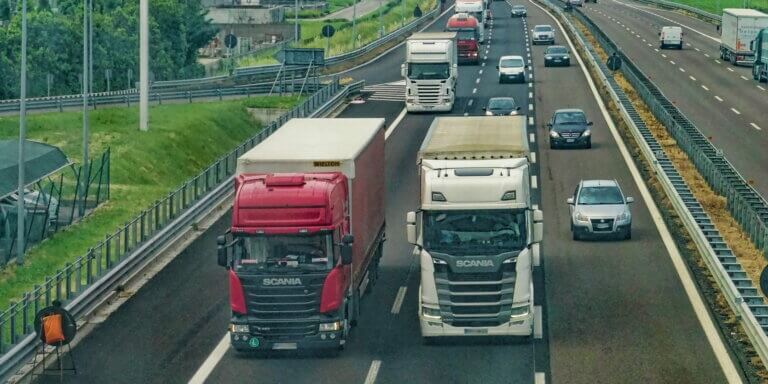
Cars and a truck passing under a railway. Source: Canva
Bridging the Gap Between Vehicle Measurement and Identification
To effectively stop an oversized vehicle before it causes damage, enforcement systems require two distinct pieces of data simultaneously: the physical dimension (“Is this truck too tall?”) and the digital identity (“Who owns this truck, and do they have a permit?”).
Historically, technologies operated in silos. LiDAR sensors excel at creating a 3D point cloud of a vehicle to measure height, width, and length at highway speeds. However, LiDAR has a critical blind spot: it cannot read text. It can confirm a truck is 14 feet tall, but it cannot determine if that specific truck holds a valid permit for that height.
Without the Vehicle Identity, the data is passive. Agencies can see that a violation occurred, but they cannot enforce it efficiently. They are forced to rely on manual visual checks, which causes backups at weigh stations and allows unsafe loads to slip through during peak hours.
HyPoint Solutions & IDOT
HyPoint Solutions, a transportation technology leader based in Madison, Wisconsin, tackled this exact “Enforcement Gap” at the Maryville Weigh Station in collaboration with the Illinois Department of Transportation (IDOT) and the Illinois State Police.
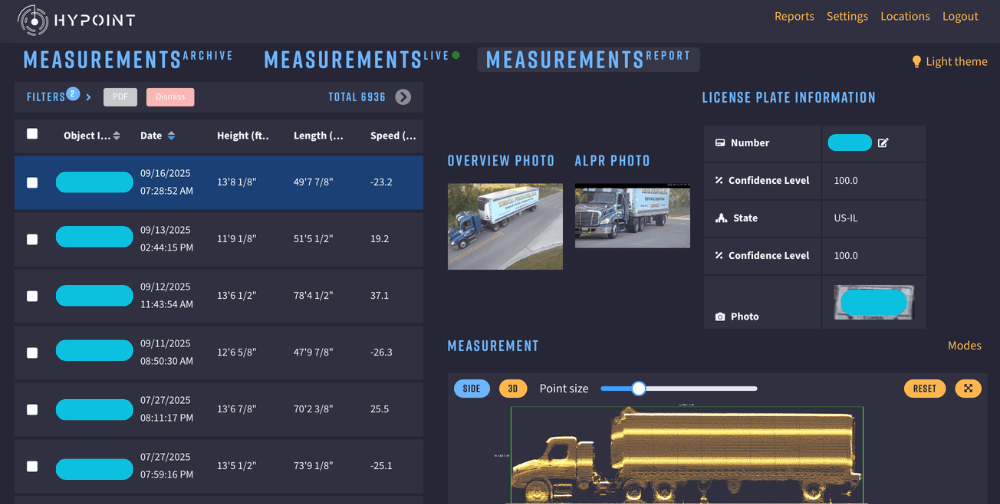
HyPoint Solutions Dashboard. Source: HyPoint Solutions
HyPoint’s existing LiDAR system provided precise dimensional data. To enable active enforcement, IDOT required a mechanism to verify valid oversized load permits automatically. The operational mandate was strict: the system had to measure the truck and read the plate in the milliseconds it takes for a vehicle to pass the sensor array, ensuring zero false positives to maintain traffic flow.
Interstate highway weigh station signs. Source: Canva
How Sensor Fusion Automates Commercial Vehicle Compliance
HyPoint integrated Plate Recognizer’s ALPR engine directly into their sensor workflow to create a seamless “Sensor Fusion” environment.
As a commercial vehicle enters the weigh station ramp, the LiDAR activates to build a 3D model verifying the truck’s height, width, and length. Simultaneously, the ALPR camera captures the license plate and the USDOT Number on the cab. The system then instantly links the physical profile from the LiDAR with the digital identity from the ALPR.
This fused data is cross-referenced against IDOT’s permit database in real-time. If a truck is oversized but holds a valid permit, it is given a green light to bypass the station. However, if the system detects an oversized load lacking the necessary documentation, it triggers a red light, flagging the vehicle for immediate inspection. This autonomous process allows officers to focus their attention solely on violators rather than compliant freight.
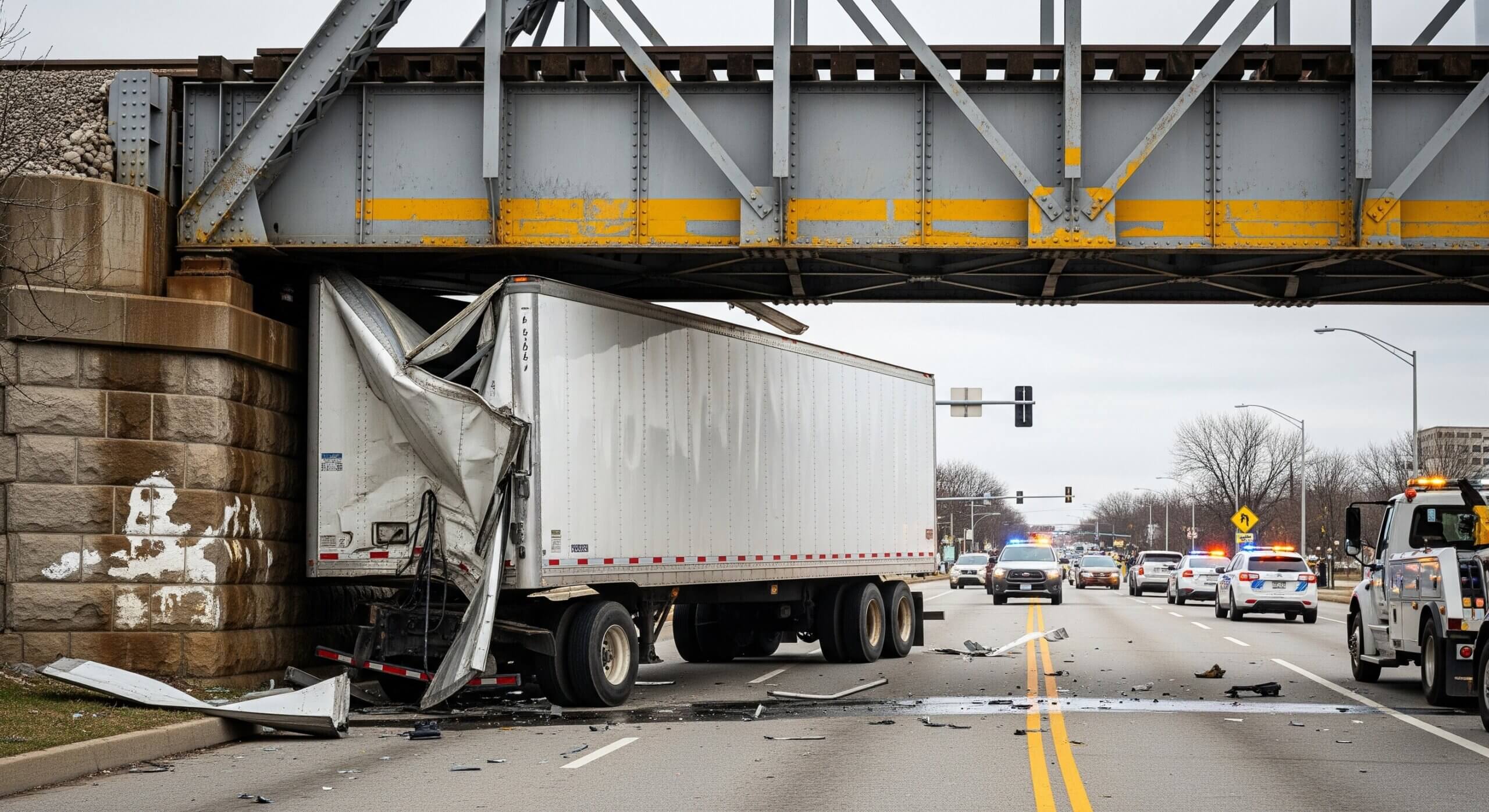
Trailer stuck under an overpass in an accident. Source: Google Generated Image
Maximizing ITS ROI with All-Weather ALPR Accuracy
However, this autonomous workflow relies entirely on continuous data capture; if the camera misses a plate, the automation fails. In Intelligent Transportation Systems (ITS), technical accuracy operates as a direct driver of Return on Investment (ROI).
Many agencies fall into the “Summer POC Trap,” testing systems in July when the weather is clear and visibility is perfect. Yet, enforcement is most critical in adverse conditions. In states like Illinois, winter brings snow, salt spray, and mud that can obscure license plates, while low sun angles create blinding glare.
By utilizing an ALPR engine specifically trained on “steep angles” and “dark/blurry” datasets, HyPoint ensured that the Maryville system remained operational 24/7/365. If the ALPR fails to read a plate during a snowstorm, the entire automated weigh station effectively goes offline, forcing officers back to manual checks. In this context, software reliability stands as the only metric that matters.
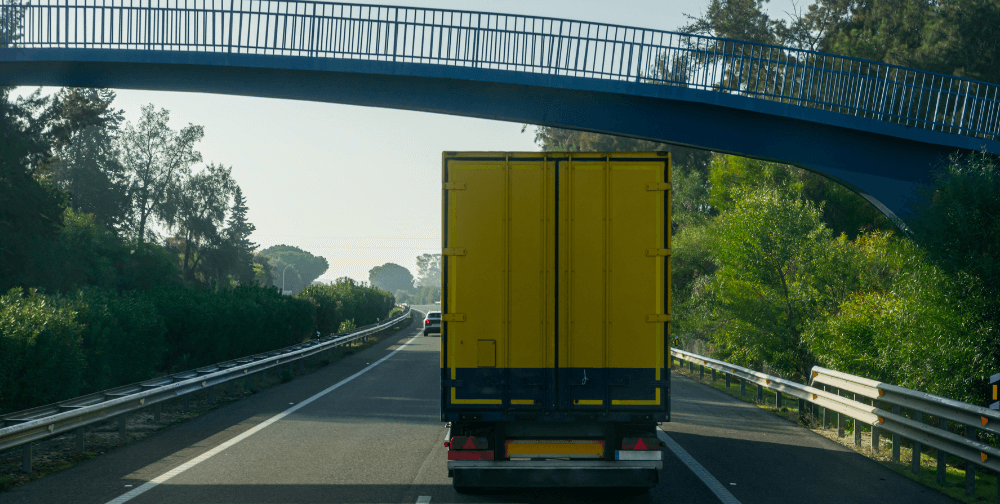
Trailer with a closed box on a highway, passing over a pedestrian bridge. Source: Canva
Transforming Passive Monitoring into Active Enforcement
The deployment at Maryville transformed the station from a passive checkpoint into an active Intelligent Enforcement Hub. This shift yields three major operational benefits:
1. Efficiency
Compliant trucks bypass the station, keeping freight moving and reducing fuel consumption from idling.
2. Infrastructure Protection
Officers receive immediate alerts for unpermitted oversized loads before they exit onto the highway where bridge strikes occur.
3. Revenue Recovery
The ability to automatically link violations to USDOT numbers ensures citations are issued accurately, recovering costs for infrastructure wear and tear.
Modernizing Virtual Weigh Stations
The HyPoint Solutions deployment demonstrates that roadway safety relies on intelligent software integration rather than hardware volume. Fusing the physical precision of LiDAR with the identification capabilities of ALPR effectively bridges the divide between detection and resolution.
Try our customized ALPR solutions for Intelligent Transportation Systems today with a free test drive. If you have more questions regarding the AI/ML engine for high-speed enforcement or full ITS deployment, send us a message anytime. We are ready to answer them.