Last updated: 01/17/2026
When organizations evaluate ALPR vendors, the focus typically falls on immediate metrics: initial accuracy, supported regions, and licensing costs.
A critical factor that receives far less attention is the lifecycle of the software once the system is in production. How are updates delivered? Do they require complex maintenance windows? And most importantly, what do those updates actually contain?
This guide compares how Plate Recognizer, Hikvision, Survision, Genetec, and Hanwha handle ALPR software updates—and what that means for IT teams, budgets, and long-term system performance.
Crucially, we also address a common misconception in the hardware market: the difference between a maintenance patch and a performance upgrades. For many camera-based vendors, a “firmware update” is often limited to security patches or network bug fixes, leaving the core recognition logic untouched.
We break down which vendors merely maintain the hardware shell versus those that continuously deliver tangible improvements to the ALPR engine itself.

Photo of Software Uploading/Updating on the screen. Source: Canva
ALPR Software Updates Can Make or Break Your Deployment
An ALPR deployment often appears straightforward at the outset: connect cameras, select a vendor, integrate with your access control or VMS, and go live. However, the conditions you test on Day 1 are rarely the conditions you face on Day 100. Real-world environments are dynamic, and static software inevitably fails in dynamic environments.
The “Summer POC” Trap: Why Winter Weather Kills ALPR Accuracy
One of the most common causes of deployment failure is the “Summer POC” trap. A Proof of Concept conducted in July might yield 99% accuracy under clear skies and long daylight hours. But come December, that same system faces snow, sleet, salt spray, and low-contrast lighting.
If your ALPR engine is “static”—meaning it resides on firmware that is never retrained—it cannot adapt to these seasonal shifts. Without software that is continuously updated with “winter-trained” datasets and “dark/blurry” optimizations, your accuracy will plummet exactly when you need it most.
Adapting to Steep Angles and New License Plate Formats
The physical environment also presents challenges that static firmware struggles to overcome. While installers typically set cameras for ideal traffic flow, driver behavior is unpredictable. Vehicles often take wide turns or approach gates at steep, unexpected angles that were not tested during the initial setup. Unless the ALPR software receives updates to improve its geometric handling, these vehicles become permanent “missed detects.”
Furthermore, state and national governments frequently release new license plate designs, such as flat digital plates or new specialty backgrounds. A static system will fail to read these new formats until a major patch is manually applied—often months later.
The Vendor Comparison: Camera-Embedded Firmware vs. Software-First ALPR
This is where the market diverges significantly. Plate Recognizer treats ALPR as a living software product, with frequent engine updates pushed on a defined cadence to address these shifting variables.
In contrast, Hikvision, Survision, and Hanwha typically couple ALPR logic directly to camera firmware. Genetec (AutoVu) delivers improvements as part of a broader, heavier VMS platform update. Selecting one of these approaches effectively commits your organization to a specific maintenance model—and a specific level of agility—for the life of the system.
What Counts as an ALPR Software or Engine Update?
In the context of ALPR, the term “update” is often misleading. For IT and security teams, it is vital to distinguish between maintaining the device’s operating system and actually improving its ability to read license plates.
Generally, updates fall into three categories, but most hardware vendors only deliver the third one.
True AI Model Updates (The “Brain” Upgrade)
This involves retraining the core neural networks to support new plate formats, enhance character recognition, and improve handling of motion blur, glare, and winter weather.
Reality: This is rarely done by traditional camera manufacturers. Once a camera is shipped, its AI model is typically “frozen.” Firmware updates almost never retrain the model to handle new conditions or plate types.
Logic & Performance Optimization
These are targeted fixes to reduce false positives, improve inference speed, or refine how the system handles difficult lighting.
Reality: Like AI updates, these performance tunings are hardly ever included in standard camera firmware. If your camera struggles with headlight glare on Day 1, a firmware update on Day 300 is unlikely to fix it.
System & Security Patches (The “OS” Patch)
These updates address security vulnerabilities (CVEs), fix network stability issues, or patch bugs in the camera’s web interface.
Reality: This is the vast majority of “updates” delivered by hardware vendors. A 500MB firmware file from Hikvision, Survision, or Hanwha is usually just a security patch. It keeps the device on the network, but it does not make the device smarter.

Three cars with Plate Recognizer on their number plates.
Delivery Divide: Software-First vs. The “Firmware Illusion”
For IT, security, and operations teams, the central question is simple: When I apply this update, does the system actually get better at its job?
Camera-Firmware Model (Hikvision, Survision, Hanwha)
In camera-embedded models, ALPR logic is locked inside the device firmware. Vendors distribute updates as heavy firmware packages that must be installed on each device.
Crucially, these manufacturers are hardware companies, not AI software companies. Their update cycles are driven by manufacturing schedules and security patches, not by AI retraining. You may perform a laborious firmware upgrade across 50 cameras only to find that the recognition accuracy hasn’t improved by a single percentage point.
The VMS-Centric Model (Genetec AutoVu)
In systems like Genetec, ALPR exists as a module within a massive security platform. Improvements are delivered through Security Center releases. While more robust than simple firmware, updates are still tied to the slow, heavy cadence of the entire VMS platform rather than the fast-moving needs of computer vision.
The Software-First Model (Plate Recognizer)
In a software-first model, the ALPR engine is decoupled from the hardware. Updates are applied directly to the software component (cloud, edge, or on-premise). Because the product is the AI, the update pipeline focuses almost exclusively on Category 1 (AI Training) and Category 2 (Performance). This ensures that the system actively learns from new data, rather than just receiving passive security patches.
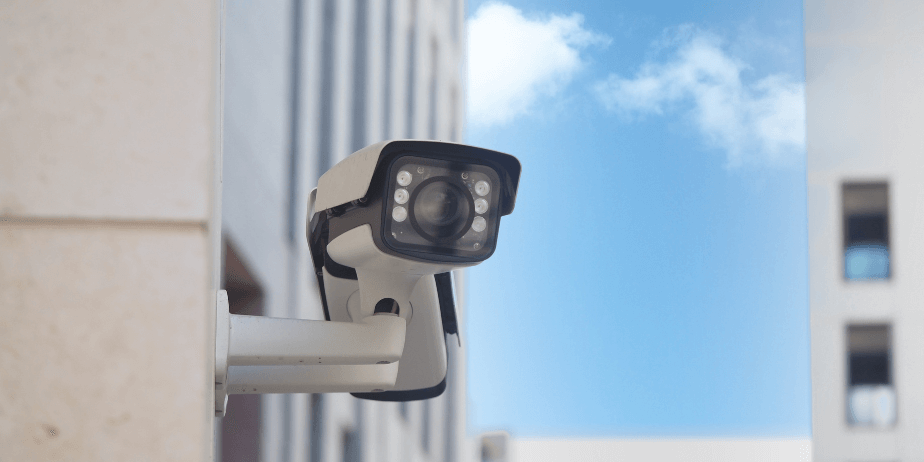
Street camera on the side of a building. Source: Canva
Overview of ALPR Update Models: Camera Firmware, VMS Platform, and Software-First
Camera-Embedded Firmware ALPR (Hikvision, Survision, Hanwha)
In a camera-embedded model, the ALPR engine is part of the camera firmware. The camera captures video, runs ALPR locally, and outputs plate reads directly from the device. When a new firmware version becomes available, it must be downloaded and applied to each camera in the deployment.
This approach has clear advantages:
- Devices are self-contained, with imaging and ALPR integrated in one housing.
- Latency is low because processing occurs at the edge rather than on a remote server.
It also presents operational limitations:
- Updates require per-device firmware upgrades via NVRs, batch tools, or web interfaces.
- Certain improvements are limited to specific camera models, so older hardware may never receive newer ALPR capabilities.
- As the number of cameras grows, firmware lifecycle management becomes a recurring operational burden. Updating 50 cameras often means 50 individual touchpoints, increasing the risk of downtime or configuration errors.
Hikvision, Survision, and Hanwha all follow this general pattern, even if the configuration tools and management portals differ.
VMS-Centric ALPR Updates in Genetec AutoVu
In the VMS-centric model, ALPR is integrated into a broader security platform. Cameras send video streams into Genetec Security Center, and AutoVu provides ALPR capabilities within that environment. Updates are delivered through Genetec Update Service (GUS) and periodic Security Center and AutoVu releases and patches.
The main benefit of this approach is centralization:
- Organizations can manage cameras, ALPR, access control, and incident workflows from a single environment.
- They work with one primary vendor for a significant portion of the security stack.
The trade-offs include:
1. VMS Ecosystem Lock-In
This is the most significant architectural constraint. Choosing a VMS-embedded ALPR solution forces your entire environment to conform to that specific platform. Unlike independent engines that work with any VMS (e.g., Network Optix, Milestone) or camera, VMS-centric ALPR restricts your ability to mix and match best-of-breed technologies.
2. Complex Update Dependencies
Upgrades must be evaluated and tested across the entire platform rather than only for the ALPR component. An ALPR update cannot be applied if it conflicts with the version of the Access Control plugin running on the same server.
3. Maintenance Costs
Access to software updates is typically tied to expensive maintenance contracts (e.g., Genetec Advantage). Without an active contract, the system remains static.
4. Rigid Change Windows
VMS updates must align with organizational change windows. You cannot simply “patch the ALPR” to fix a read error; you must plan a platform-wide upgrade.
In practice, ALPR improvements progress on the platform’s slow release cycle rather than on an independent, fast-moving ALPR engine cadence.
Software-First, Hardware-Agnostic ALPR Updates with Plate Recognizer
Plate Recognizer adopts a software-first, hardware-agnostic model. ALPR runs as software in the cloud, on an edge device, or on-premises and connects to any IP camera or RTSP feed that meets basic quality and resolution requirements. The ALPR engine is updated on a regular 3–6 week cadence, with continuous training and tuning applied to the model.
This model offers several advantages:
- Engine updates are delivered as software releases, so many cameras benefit from a single upgrade.
- Organizations can reuse existing camera infrastructure across multiple brands.
- Unlike VMS-centric models, customers are not dependent on a specific VMS vendor. The engine works alongside any platform (e.g., Network Optix, Milestone) or independently, providing full architectural flexibility.
- Per-camera firmware upgrades are not required to take advantage of engine improvements. Getting the latest accuracy updates is simple for IT teams—often just a single Docker update command—rather than flashing firmware on individual devices.
The main considerations are architectural. The deployment requires a server, edge device, or cloud environment, and the network must be designed and sized appropriately to support video streaming from cameras to the ALPR engine. In exchange, ALPR is treated as a modern, continuously improving software product.
Plate Recognizer vs Hikvision, Survision, Genetec & Hanwha
Vendor Comparison: ALPR Software Updates for Plate Recognizer, Hikvision, Survision, Genetec, and Hanwha
The following sections compare how Plate Recognizer, Hikvision, Survision, Genetec, and Hanwha manage ALPR software updates across several dimensions: update frequency, delivery method, cost of staying current, hardware lock-in, scalability, and transparency.
Update Frequency: How Often Do ALPR Engines Receive New Software Updates?
- Plate Recognizer updates its ALPR engine on a regular 3–6 week cadence, with continuous model improvements feeding into each release.
- Hikvision delivers ALPR-related enhancements periodically within broader camera firmware updates, with a frequency that can vary by model, product line, and region.
- Survision typically releases ALPR updates alongside major firmware or product updates and does not publicly commit to a specific ALPR-focused schedule.
- Genetec AutoVu provides ALPR improvements several times per year as part of Security Center and AutoVu releases and patches.
- Hanwha embeds ALPR enhancements within camera firmware updates aligned with its firmware release cycle.
A predictable and frequent update cadence makes it easier for organizations to maintain high recognition accuracy as plate formats, lighting environments, and deployment conditions change.
Update Delivery Method: Automatic ALPR Software Updates vs Manual Firmware Upgrades
- Plate Recognizer delivers updates via software deployments to cloud, edge, or on-premises environments. A single update to the ALPR engine can apply to many cameras, since the recognition logic resides in a central service or node rather than in each device. For strategic customers, this model allows for custom Machine Learning updates: engineers carefully analyze specific misread images and deliver a new, targeted beta release in just 3–6 weeks.
- Hikvision relies on firmware upgrades applied to individual cameras, and some devices must progress through intermediate firmware versions before reaching the latest release.
- Survision uses firmware packages uploaded through its management tools, which requires devices to be reachable and managed individually or in batches.
- Genetec AutoVu upgrades are coordinated by administrators through Genetec Update Service and affect servers, services, and components within Security Center.
- Hanwha manages firmware via NVRs or vendor utilities and deploys new firmware to each camera.
Automatic, centralized software updates reduce the ongoing workload for IT and operations teams. Firmware-heavy and tightly coupled VMS updates demand more planning, coordination, and manual effort whenever ALPR improvements are released.
Cost of Staying Current: ALPR Software Updates, Maintenance Plans, and Hardware Refresh
With Plate Recognizer, ALPR software updates are included in the subscription, and there is no separate fee for engine update access.
For Hikvision, firmware downloads are free, but access to certain ALPR capabilities may require specific camera models or ALPR-specific SKUs, which can lead to hardware upgrades over time.
Survision provides firmware updates while the product remains within its support lifecycle; once a device reaches end-of-support, it may no longer receive new ALPR improvements.
Genetec AutoVu ties access to new versions and patches to an active maintenance plan, such as Genetec Advantage, and environments without such a plan often remain on older versions.
Hanwha makes firmware available without charge, but ALPR functionality depends on particular camera lines and associated licensing.
Frequency of AI vs. Firmware Updates
A critical “hidden cost” for hardware vendors is the stagnation of intelligence. For vendors like Hikvision, Hanwha, and Survision, a “firmware update” typically contains security patches or OS bug fixes—not AI improvements.
- Hikvision & Hanwha – AI model updates are extremely rare, often occurring only once every 12–18 months (if at all) and are usually tied to purchasing a new generation of camera hardware.
- Survision – Does not publish a separate AI update schedule; improvements are bundled into infrequent firmware releases.
- Plate Recognizer – Delivers dedicated AI engine updates every 3–6 weeks. This means your system actively “learns” new vehicle types and plate formats 10x faster than a camera-based competitor, without requiring a hardware swap.
When evaluating the cost of staying current, it is important to consider:
- The annual cost of mandatory support plans (like Genetec Advantage) just to access updates.
- The staff time required to plan, test, and manually “fiddle” with firmware updates on individual cameras.
- The hidden cost of having to replace functioning cameras just to get access to the latest AI features.
- The operational loss caused by running “frozen” AI models that fail to adapt to new license plates or environmental changes over time.
These factors collectively shape the total cost of ownership (TCO) for ALPR, often making a “free firmware” model more expensive in the long run than a subscription-based software model.
Hardware Lock-In vs Hardware-Agnostic ALPR Software
Plate Recognizer is designed to work with any IP camera or RTSP feed that meets technical requirements, enabling organizations to reuse existing hardware and operate mixed-vendor environments.
In contrast:
- Hikvision ALPR functionality is supported on Hikvision ALPR-capable cameras running appropriate firmware.
- Survision requires Survision-branded cameras, where ALPR is integrated at the device level.
- Genetec AutoVu is optimized for Genetec-approved hardware and deep integration with the Security Center ecosystem.
- Hanwha ties ALPR features to specific Hanwha camera lines with associated firmware support.
Hardware lock-in can be acceptable in tightly controlled environments, but it may limit flexibility during future expansions, technology refreshes, or vendor changes. A hardware-agnostic software approach provides more options over the system’s lifecycle and can simplify procurement and integration across diverse sites.
Scalability and Maintenance Load for Multi-Site ALPR Deployments
Scaling from a small pilot to a large, multi-site deployment has direct consequences for update strategies.
With Plate Recognizer, scaling typically involves adding streams and compute resources—more servers, additional edge devices, or expanded cloud capacity. The update process remains centralized; upgrading the ALPR engine software benefits all connected cameras.
With Hikvision, Survision, and Hanwha, scaling often means deploying additional ALPR-enabled cameras. Each firmware cycle becomes more complex as the number of devices grows. Teams must coordinate downtimes, validate updates, and monitor many endpoints. For Genetec AutoVu, scale comes through additional licenses, cameras, and servers within Security Center, but major updates require testing in staging environments and structured deployment plans to maintain stability.
Manual update processes may be manageable in small environments. As deployments grow, the cumulative maintenance effort increases, and organizations may defer updates, resulting in missed ALPR improvements and slower adoption of new capabilities.
Transparency of ALPR Software Update Cadence and Release Notes
Plate Recognizer provides a defined update cadence and release notes that explicitly describe changes to the ALPR engine and related components. Customers can track when improvements become available and what has been modified.
Hikvision, Survision, Hanwha, and Genetec typically publish firmware and platform release notes, but ALPR-specific improvements are often described within broader documentation.
There is less emphasis on a clearly communicated ALPR engine roadmap and cadence.
For organizations that prioritize governance, auditability, and change management, clear visibility into update timing and content supports better planning, risk assessment, and compliance.
Plate Recognizer’s Approach to ALPR Software Updates
Within this landscape, Plate Recognizer represents a software-first, hardware-agnostic ALPR solution. It provides frequent ALPR software updates on a clear cadence, delivers automatic engine improvements without requiring per-camera firmware changes, and supports deployment across cloud, edge, and on-premises environments. It integrates with existing parking systems, access control platforms, and VMS solutions rather than requiring a complete replacement of the existing stack.
This model is well-suited to organizations that:
- Want ALPR accuracy and coverage to improve continuously.
- Prefer flexibility in camera hardware and infrastructure.
- Anticipate growth from pilot deployments to larger, multi-site systems.
If this software-first approach to ALPR updates fits your requirements, you can test Plate Recognizer for free by signing up for an account and running the engine on your own camera feeds. For questions about deployment options, integrations, or update behavior, send us a message anytime—our team is ready to help.
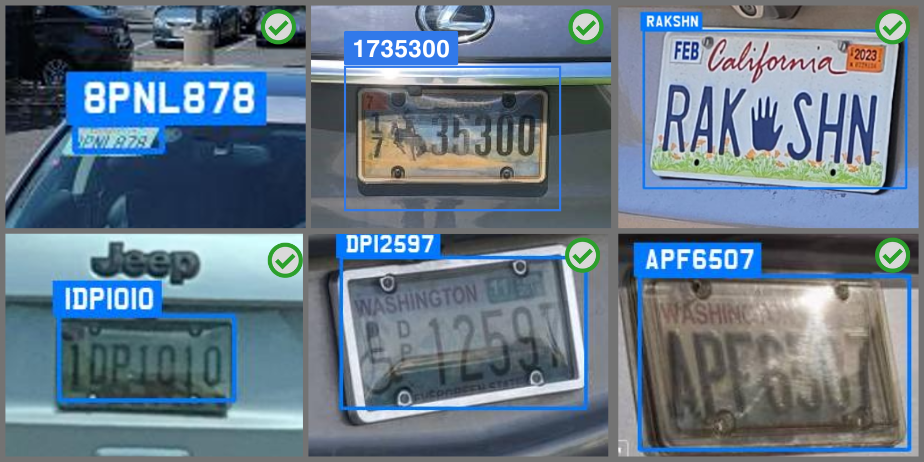
Plate numbers recognized through Plate Recognizer ALPR. Source: Plate Recognizer
FAQ
What are ALPR software updates?
ALPR software updates are changes to the recognition engine and related components that improve how license plates are detected, read, and processed. They can include support for new plate formats, accuracy improvements, performance tuning, and updates to APIs or integration features.
Why are regular ALPR engine updates important?
Plate designs, road conditions, lighting, and operational requirements change over time. Regular ALPR engine updates help maintain accuracy and reliability under these changing conditions, so performance does not slowly degrade over the life of the deployment.
How often should ALPR software or firmware be updated?
For software-first ALPR, adopting new engine releases on a predictable schedule—such as every few weeks or months—helps keep performance aligned with current conditions. For camera firmware or VMS-based ALPR, many organizations plan one or two structured update cycles per year, balancing improvement with operational effort.
Are camera firmware updates sufficient on their own?
Camera firmware updates are necessary in embedded ALPR models, but they usually occur less frequently and require more manual work than software-first updates. A dedicated ALPR engine that can be updated independently and more often gives organizations greater flexibility to respond to new plate types and edge cases.
Can existing IP cameras be used with frequently updated ALPR software?
Yes, in a software-first model such as Plate Recognizer’s, existing IP cameras can send video via RTSP or ONVIF to a central ALPR engine. Updates are applied to that engine rather than to each camera, which simplifies ongoing maintenance while allowing organizations to retain their current camera infrastructure.